UC Physicians Committee
UC physicians Are Forming A Union for Our Patients.
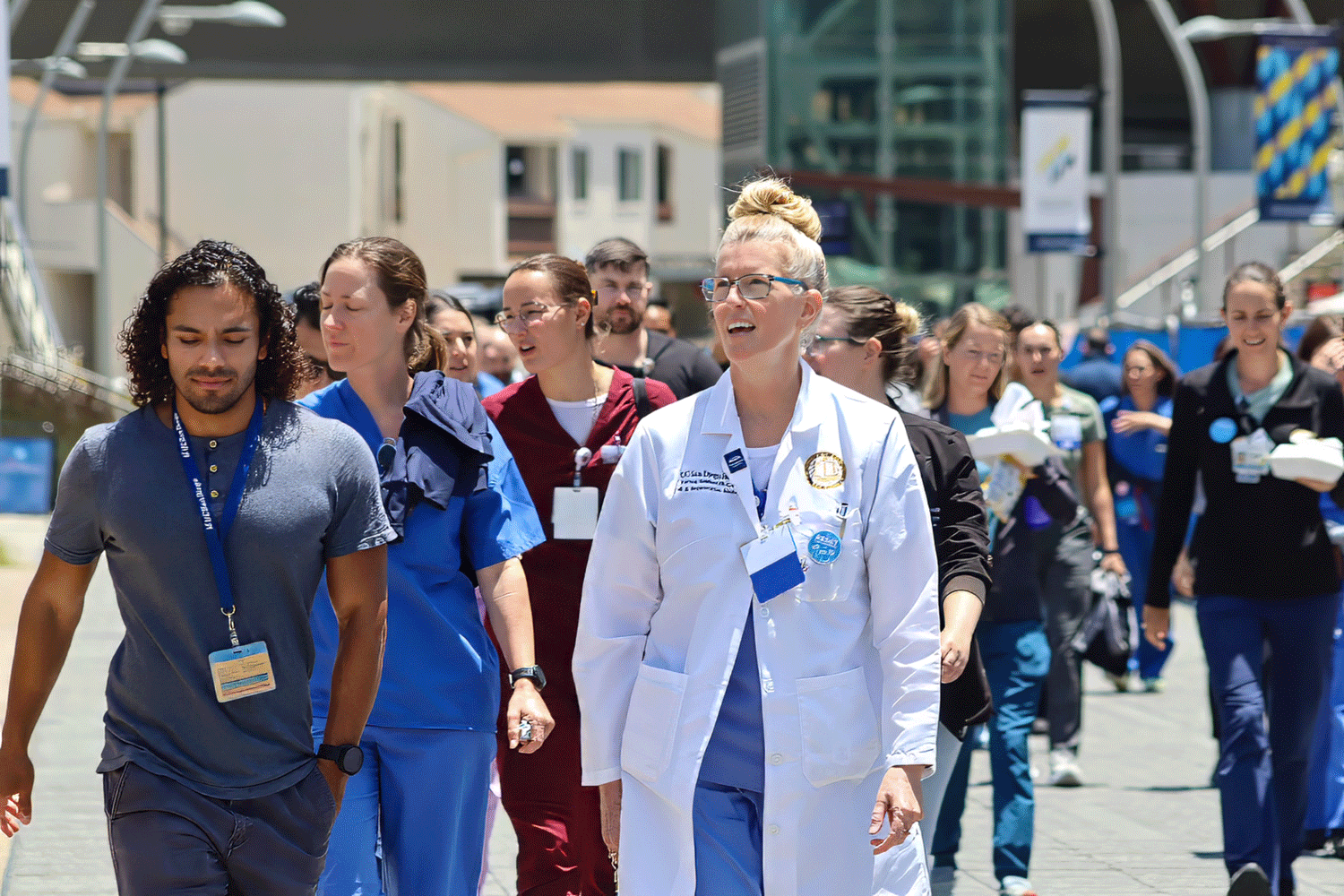
Across the UC system, physicians are uniting to build a stronger voice for our patients, our profession, and the future of healthcare. With the support of our UPTE colleagues, we have formed the UC Physicians Committee to have a united voice in the decisions that affect patient care.
What Is the UC Physicians Committee?
Physician influence over healthcare decisions has declined, even as challenges facing patient care continue to grow. For that reason, physicians from every specialty and every UC campus have united to form the UC Physicians Committee, with the goal of establishing a union that gives physicians a voice in decision making that impacts us and our patients.
Unionization is the path forward because it provides what physicians currently lack: a protected collective voice and real bargaining power. UC physicians are stepping forward to lead for our patients, for the future physicians we train, and for the future of medicine.
Why are UC Physicians Forming a Union?
-
Every day, we are asked to provide excellent care despite ongoing shortages of staff, equipment, and clinical resources. Many physicians lack adequate support staff, and some have even taken the step of paying for additional support out of their own pocket to meet patient needs.
We frequently see patients in hallways, auditoriums, tents, and other makeshift treatment spaces that lack privacy and appropriate equipment. We are forced to rely on temporary workarounds rather than the resources that should be standard in a world-class health system.
We believe our patients deserve safe, timely, and dignified care. To achieve that, physicians need a stronger voice in advocating for the staffing, infrastructure, and resources required to deliver the care our communities expect.
-
Each year, productivity expectations continue to rise. RVU targets increase while the time available for patient visits becomes more limited.
We entered medicine to care for patients, not simply to meet productivity metrics. Meaningful patient care requires time to listen, diagnose, educate, coordinate treatment, and answer questions. When physicians are pressured to see more patients in less time, the quality of care suffers.
We believe physicians should have a voice in determining how productivity expectations are balanced with patient safety, quality, and access to care.
-
Research has consistently shown that physician-led health systems achieve better outcomes. Organizations such as Mayo Clinic have demonstrated the value of physician leadership, collaboration, and engagement in decision-making. We believe UC physicians should have a stronger role in shaping the policies and priorities that affect our patients and our practice.
The COVID-19 pandemic highlighted the consequences of limited physician involvement. Many of us experienced rapid policy changes and significant workplace impacts without adequate physician representation in the decision-making process. Looking ahead, challenges such as Medicaid funding instability, increasing numbers of uninsured patients, and growing demand for care will require thoughtful planning and physician leadership.
A union provides a unified mechanism for physicians to participate meaningfully in decisions that affect patient care across the UC system.
-
UC trains some of the most talented physicians in the country, yet many choose not to remain in the system after completing their training.
Across departments, physicians have witnessed high turnover, persistent vacancies, and growing recruitment challenges. In some areas, staffing shortages have resulted in increased reliance on part-time coverage and disruptions in continuity of care.
We want UC to be a place where outstanding physicians choose to build long-term careers. Recruiting and retaining talented physicians requires a workplace where physicians feel respected, supported, and empowered to provide excellent patient care.
-
We see the consequences of overcrowding, boarding, and capacity constraints every day. Patients wait hours for care, emergency departments operate beyond capacity, and delays ripple throughout the hospital.
Across UC, the data reveal a system under strain. At UCLA, patients leave the ED without being seen at rates far above state and national averages, while ambulance diversion reached more than 50% of ER hours at Ronald Reagan in 2023—nearly ten times the state average. At UCSD Hillcrest, nearly 7% of patients left without being seen, almost triple the California average, and patients spent an average of 305 minutes in the ED before leaving. At UC Davis, ER visits increased while emergency department staffing fell by 20%, and patients spent an average of 342 minutes in the ED. At UCSF, patients wait nearly five hours in the emergency department, and ambulance diversion more than doubled between 2018 and 2023.
The boarding crisis affects far more than the emergency department. When admitted patients cannot get inpatient beds, they remain in the ED, creating bottlenecks throughout the hospital. Across UC medical centers, average lengths of stay have increased substantially, reflecting growing challenges moving patients through the system. Research shows prolonged hospital stays are associated with worse outcomes, including increased mortality.
Physicians have repeatedly raised concerns and proposed solutions, but too often the people closest to these challenges are excluded from decisions about how to address them. We are organizing because patients deserve timely access to care, and physicians should have a meaningful voice in solving the capacity and throughput challenges facing UC hospitals.
Hear from physicians
-
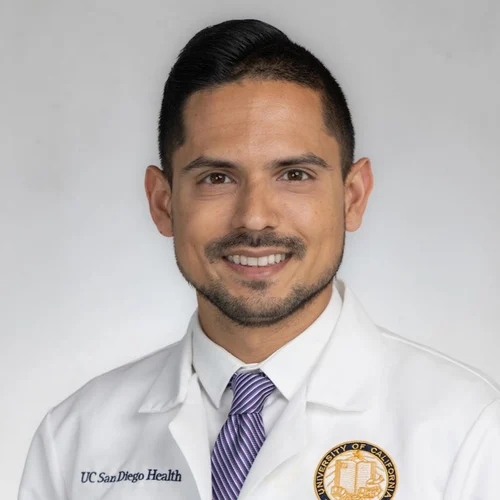
Jonathan McIntyre, MD
"It’s difficult to provide the level of care our patients deserve when we don’t have the resources we need. We are forced to see patients in hallways and an auditorium separated only by sheets, treating them in spaces that lack privacy and the equipment necessary to provide safe care. We need more resources, better staffing, and a stronger voice in the decisions that affect patient care. That’s why I support unionization, so physicians can collectively advocate for our patients.”
Hospital Medicine, UC San Diego
-
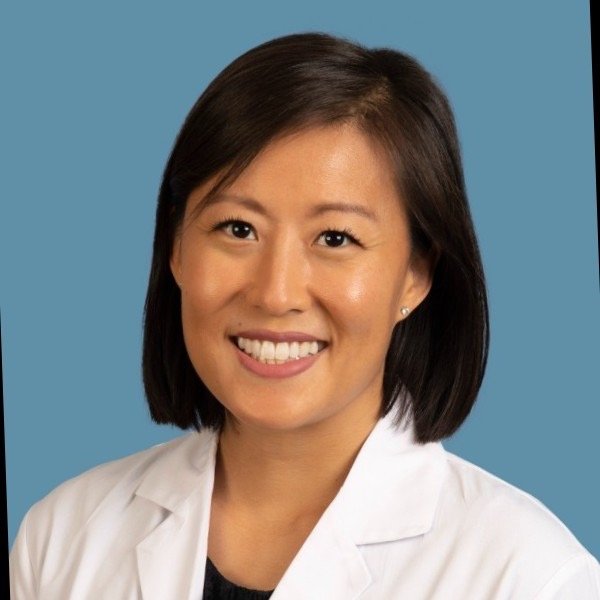
Judy Choe, DO, MDA
“The ED boarding crisis is harming not only our patients, but also us as physicians. After treating patients in lobbies, hallways, and tents for years, it is clear this crisis is only getting worse. Physicians need a voice to advocate for patient care and meaningfully address the boarding crisis.”
Emergency Medicine, UC Los Angeles
-

Nicole Cresalia, MD
“Our Pediatric Heart Center performs incredible surgeries but we are finding that the differences in morbidity for children is less on the inpatient and surgical side but in the outpatient areas where UC provides the least resources. As physicians we would never let anything adverse happen to our patients, but the cost of this lack of support falls overwhelmingly on us and our patients. As I speak with physicians across specialties, we hear the same thing: health system leadership does not act on the concerns we raise. It’s time for physicians to unionize because demands for productivity should not take priority over providing quality patient care.“
Cardiology, UC San Francisco
-
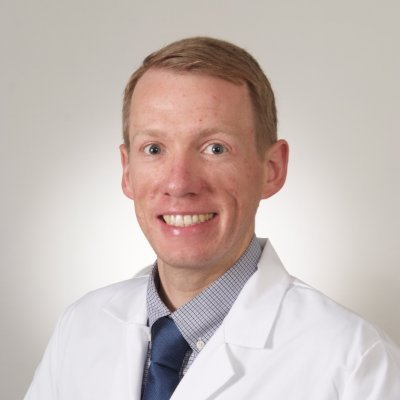
Kurt Schaberg, MD
"Physician burnout is a huge problem. We lose great physicians every year. One year, half of my department quit. There are some years where we don't have any surgeons from specific subspecialities at all, which means we can't properly treat many of our patients without referring them to other hospitals. We need sustainable workloads, adequate resources, and fair compensation, which will only come when physicians are able to speak with a stronger voice."
Pathology, UC Davis
Roadmap
What are the steps to unionization?
1. Build Support
Physicians form our committee of respected point people, engage our colleagues to identify their top priorities, and gather unionization support via our Unionization Survey.
2. Vote to Unionize
As we near a majority of surveys completed with broad involvement by doctors across specialities, we plan a unionization vote for all physicians to vote to form a union.
3. Secure
Union Certification
The state labor board, PERB, certifies majority support for unionization.
4. Access Benefits & Start Bargaining
Physicians and clinical faculty receive the improved benefits of the Healthcare (HX) contract, and vote to elect a bargaining team to begin to bargain over physician-specific issues.
The UPTE Difference
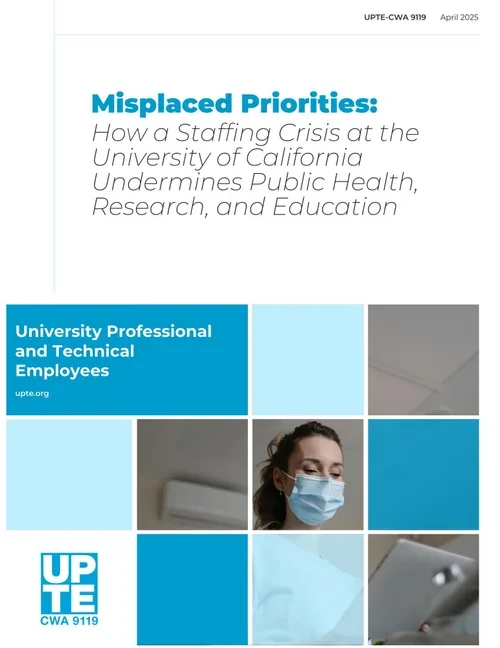
Misplaced Priorities
Frontline staff across the UC system endure a long-standing staffing crisis, while the university flaunts billions acquisitions, building and other capital projects, and endless administrative bloat resulting in care deficiencies and slowed research.
As California’s third-largest employer, UC shapes market standards and generates $82 billion in annual economic activity. Given their enormous ability to influence the lives of every Californian, UC must do better.
Staffing levels cannot afford further deterioration while executives prioritize investment returns and market share over the public good. UC must choose to safeguard the future of patient care, research, and education.
Frequently Asked Questions
Still have questions? Take a look at the FAQ or reach out anytime. If you’re feeling ready, go ahead and apply.
-
We need a stronger collective voice to advocate for our patients, our colleagues, and our profession. Each year, we absorb increased pressures, new demands, and make herculean efforts to care for our patients. Our individual advocacy is not enough. Time has come for UC physicians to have a collective voice.
-
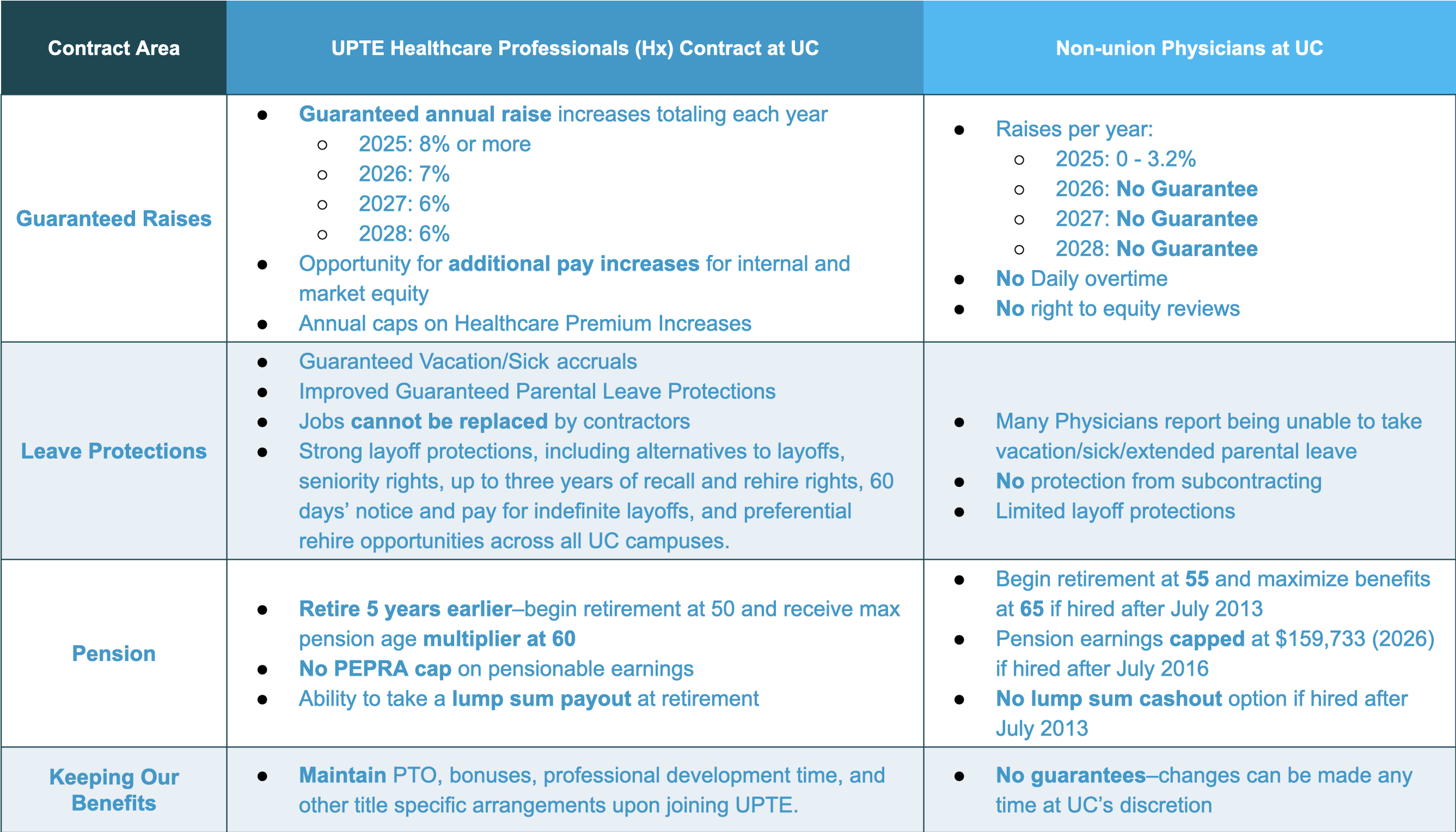
Healthcare professionals at UC, including Pharmacists, Physician Assistants, Dentists, Optometrists, Psychologists, and more, currently receive improved benefits and protections that physicians do not. These disparities fuel retention challenges, impacting patient access and quality of care. Improved benefits under the UPTE Healthcare (HX) contract include:
Full retirement at age 60 (instead of 65), with no PEPRA cap (currently $159,733 annually) on retirement benefits
Guaranteed annual raises/cost-of-living adjustments, 8% in 2025, 7% in 2026, and 6% in 2027 and 2028
Reduced healthcare premiums and caps on premium increases
Improved protected parental leave of up to a year
-
It is important for physicians to form our own union led by a representative body covering every major medical specialty and each UC Health System. This effort emerged from many conversations with healthcare professional colleagues in UPTE last year during the height of their successful campaign to win a powerful new contract. Forming our committee with UPTE’s backing presents several advantages for physicians:
Extending the improved pay and benefits of the UPTE Healthcare (HX) contract to physicians is the fastest route to immediately address the pressures on our physician colleagues and improve recruitment and retention. Adopting the superior pension, healthcare, leaves, and job security protections of the UPTE contract as a baseline would allow physicians to focus our bargaining efforts on the issues most important to us: resource constraints, support staffing, and a voice in health system policy and decision-making that shape our ability to give quality care.
The strongest drive for forming our physicians union comes from our desire for a collective voice in issues impacting patient care and research. UPTE’s healthcare professionals are effective at moving the UC regents. Our joint efforts to improve patient care strengthen our campaign for a physicians union.
Starting from zero with a union that does not have a career-staff contract at UC Health would likely lead to years of bargaining before physicians see any benefits from a union agreement.
-
Yes. Under California’s state law, the Higher Education and Employment Relations Act (HEERA), the UC is prohibited from barring or interfering with your right to speak with your colleagues about unionization. You may discuss the union in any context that colleagues might otherwise talk about sports, the weather, or a family vacation. If a member of management or leadership makes you feel like your outreach is inappropriate, please contact us here to let us know.
-
Step 1: Physicians form our committee of physician point people in each division and specialty, engage our colleagues to identify their top priorities, and gather support via our union support card and priorities survey.
Step 2: Once a near-majority of doctors across specialties complete our surveys, we will hold a union election for all physicians to vote to form a union.
Step 3: California’s Public Employment Relations Board (PERB) certifies majority support for unionization. Physicians and clinical faculty receive the improved benefits of UPTE’s Healthcare (HX) contract.
Step 4: Physicians/Clinical Faculty vote to elect a bargaining team to begin to bargain over physician-specific issues.
-
While you may be contacted by a national union, we ask that you refrain from signing a card with an outside organization so that our unionization effort can remain united. The American College of Physicians (ACP) recommends that physicians organize together with existing unions of healthcare professionals dedicated to patient care in their health systems. Unionization with an outside union would mean years of re-litigating the improved pension, leaves, and benefits standards healthcare professionals like Pharmacists and PAs in UPTE have already set. If you have already signed a card with another union, you may revoke that card.
-
If you have not done so already, fill out your priorities survey and support card today at uc-physicians.org/survey. Once you have done that, reach out to our UC Physicians Committee organizing team here to help set up a department meeting in your area, help with survey outreach, or answer other questions.
-
Our unionization effort includes all physicians and clinical faculty across the state, including senate-covered faculty. Physicians in ClinX titles will need to form a new bargaining unit but will benefit from benchmarking their demands to the standards already set by the Healthcare Professionals contract.
-
Yes. Physicians are permitted to unionize under the relevant California state law, the Higher Education Employment Relations Act (HEERA). The law also prohibits the UC from interfering with physician organizing, from sending out anti-union communications, or from retaliating against employees for union activity.
-
No. A physician strike will not be called without a majority vote by all UC doctors. By organizing a high-participation campaign where all physician divisions and specialties are represented, we aim to win contractual guarantees on physician top priorities without the need for disruptions to patient care.
-
No. Physicians will begin to receive guaranteed percentage cost of living adjustments in the Healthcare Professionals contract. Reductions to incentive pay are explicitly prohibited. Any further changes to physician compensation — such as market adjustments for below-market specialties — will be bargained with the UC system by an elected physician bargaining team. Division or specialty compensation arrangements will not change unless negotiated and agreed to by physicians and the UC system. Incentive pay reductions are specifically prohibited by the UPTE-UC contract.
-
As physicians from distinct departments and specialties have started to come together, the commonality of our issues has been more striking than the differences. The distinct concerns of our specialties underscore the importance of forming a union with a structure that represents every department and specialty. This is a feature already reflected in UPTE’s Healthcare contract: guaranteed protected time for a respected colleague to represent each group in union matters.
-
As we prepare for bargaining, we will engage in a broad campaign of consultation to identify and rank physician priorities, including a series of division meetings, a bargaining survey, and more. Physicians will elect a physician/faculty bargaining team representing every health system in the state who are charged with consulting with physicians at their health system alongside the broader committee of physician leaders.
-
The UC Physicians Committee is made up of physicians from all major specialties and UC health systems across the state. The Committee is rapidly growing by engaging more of our colleagues as we identify their top priorities and prepare to form our union. Physicians are leading this organizing effort and will determine the priorities once we reach the bargaining table. Once we have secured our union, the UPTE Healthcare Professionals contract ensures monthly paid protected time for physician representatives. Your division or specialty may choose a physician to represent you and your group’s particular needs and priorities.
-
Some UC management communications have incorrectly indicated that Medical Directors and other physicians in leadership roles are not eligible. This is not true. Only physicians with hiring, firing, and discipline powers, and who do not spend a majority of their time performing physician work, are legally “supervisors” and excluded from the union. Physicians with leadership positions have a unique view into the challenges of making physician perspectives heard in health system decision-making, and their participation in forming our union will give confidence and strength to their colleagues.
-
Signing a union card brings us closer to achieving majority support for our union. Given the potential impacts on the health system of impending cuts to Medicaid taking effect in January 2027, the protections of a union contract are of heightened importance. Once the UC Physicians Committee reaches majority support for our union, PERB will certify unionization. From the date our union is certified, the UC system will no longer be allowed to unilaterally reduce physician compensation or otherwise change physician working conditions without bargaining with physicians. We immediately gain protections against layoffs and subcontracting. Achieving collective bargaining rights ahead of these cuts puts physicians in a much stronger position to protect resources for direct patient care and research at a critical time.
-
Yes. UPTE’s Healthcare Professionals contract benefits already extend to clinicians who work at non-UC hospitals or programs. Physicians working in these settings will enjoy the full range of protections upon unionization as well.
-
UPTE healthcare professionals have won additional staffing in a variety of settings, from Nurse Navigators, Physical Therapists, Pharmacists to Clinical Laboratory Scientists. UPTE healthcare professionals have successfully defended dedicated service-line assignments for specialized support staff, improved equipment and retraining, and blown the whistle over the impacts of the hospital boarding crisis and long specialty care wait-times, exacerbated by short-staffing and other health system resource allocation decisions. Once physicians unionize with the Healthcare Professionals Unit, they will gain the legal right to bargain over support-staffing levels and more. Additional patient advocacy wins include: reversing the closure of the UCI Focus clinic (the only comprehensive treatment center for pediatric victims of sexual assault in Orange County), expanding MD positions in the Department of Psychiatry at UCSD, reversing the layoffs of badly-needed specialized Physical Therapists at UCSF, and more.
-
Union dues will be a maximum of 1.3%, with a function rate at a fraction of a percent for most physicians. Union dues are capped at $160 per month. Dues fund organizing staff, our legal team, research and communications staff, and bargaining and organizing expenses. Physicians/Faculty will not pay dues until we receive the first union contractual raise.
-
Yes! Faculty members like Psychologists, Physicists, Nursing Faculty, Pharmacists, Researchers, Physical Therapists, Public Health Advocates, and others are organizing alongside our Physician colleagues to join healthcare professionals already in UPTE. We know that we share many of the same concerns and often face barriers due to the lack of support staffing, resources, and meaningful voices within the institution. By organizing together we will have a real seat at the table to advocate for our patients, research, students, and communities. Click here to book a time with one of our Faculty Representatives to learn more.
Want more info?
Book time to speak with
your Campus Representative